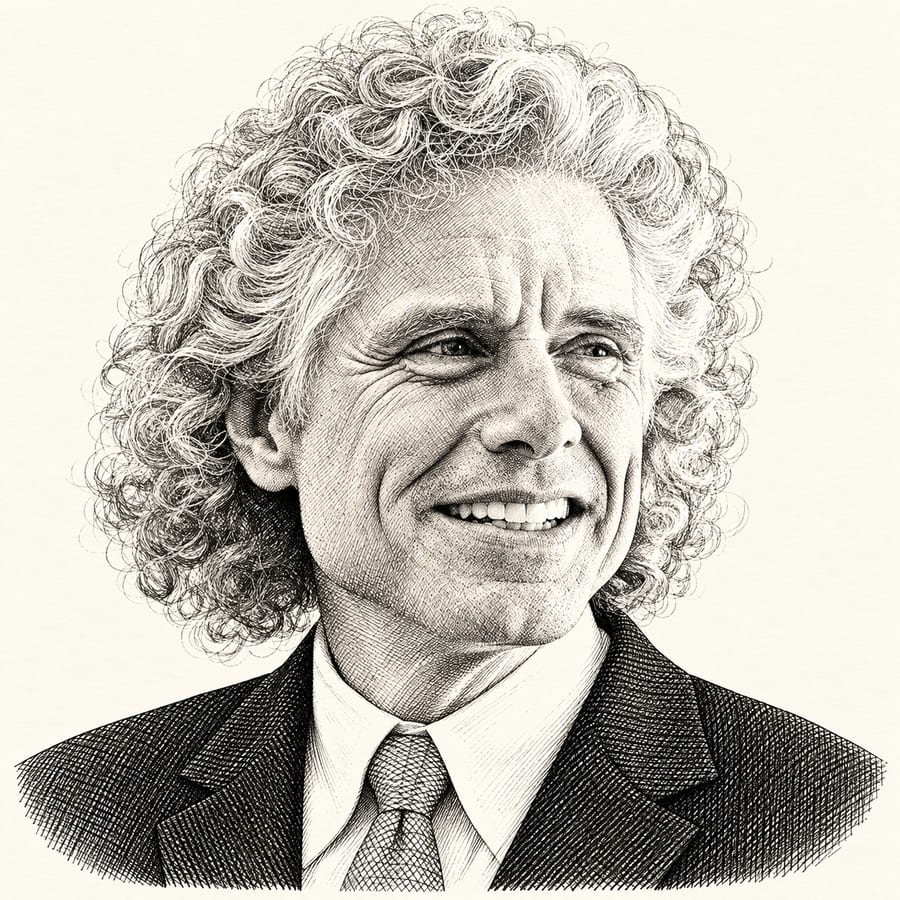
Steven Pinker, The Language Instinct
Nobody teaches children grammar, so why do they speak? Pinker answers that language is an instinct. Creoles and Nicaraguan Sign Language, evidence from brain and genes, a check on the Sapir–Whorf hypothesis, the language of thought, and the tree of grammar, in eight articles (preface and chapters 1–4).
Is Language Learned or Born? Pinker's The Language Instinct in Ten Minutes
Nobody teaches children grammar, so why do they come to speak? Pinker's answer is that language is an instinct. The shape of the argument, the four kinds of evidence behind it, and where this series goes.
Is Language a Cultural Invention, or an Instinct? The Spider's Web and Stone Age Grammar
Pinker rejects the common view that language is humanity's greatest invention. The spider-web analogy, Darwin's 1871 observation, first contact in the New Guinea highlands, and his answer to the objection that 'universal' does not mean 'innate.'
Do Children Really "Invent" Language? Pidgins, Creoles, and Nicaraguan Sign Language
Adults speak a clumsy makeshift jargon; their children rebuild it into a new language with complex grammar. Hawaiian Creole, the sign language born in Nicaraguan deaf schools, and Simon, the boy who signed better than his parents.
Why Do Children Know Grammar They Were Never Taught? The Poverty of the Stimulus and the Question Experiments
Parents don't teach grammar, yet three-year-olds use "-s" correctly over ninety percent of the time and pick the right "is" when making a question. Chomsky's poverty-of-the-stimulus argument, checked with a unicorn question and an experiment with Jabba the Hutt.
Can Language Break Alone, or Survive Alone? Broca's Aphasia, SLI, and Williams Syndrome
Some people lose grammar while the rest of their intelligence is intact. Others are severely impaired in intelligence yet talk fluently. What this double dissociation does to the view that language is just general smarts.
Does Language Determine Thought? The Sapir–Whorf Hypothesis and the Eskimo-Snow Myth
"Newspeak," "the Hopi have no concept of time," "Eskimos have hundreds of words for snow." How much of this is true? Pinker checks Whorf's argument and three of his examples: colour words, Hopi time, and snow.
What Language Do We Think In? The "Language of Thought" (Mentalese) Hypothesis
How do babies, monkeys, and adults with no language think without words? Rotating letters in the mind, Turing's machine, and the trap in "Ralph is an elephant." Why Pinker argues that English cannot be the medium of thought.
Why Is a Sentence a Tree and Not a Chain? Pinker on the Basic Design of Grammar
"Dog bites man" is not news; "man bites dog" is. Language is built not from a simple rule for lining up words but from nested trees. Why word-chain devices fail and what phrase-structure grammar solves, tested on "either … or."