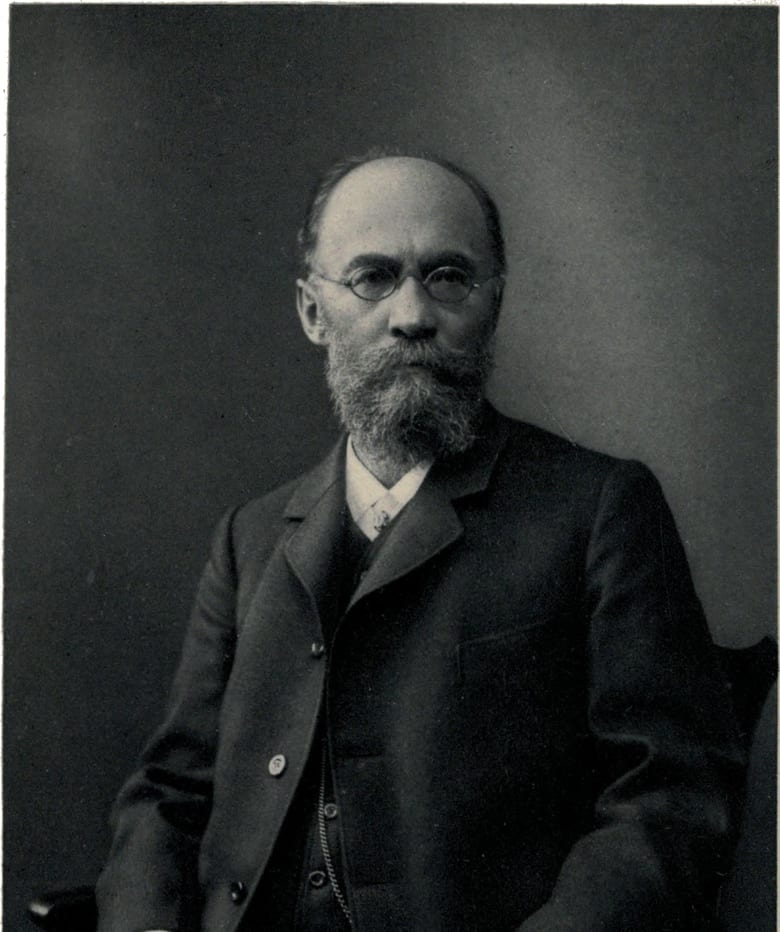
Eighteen years after the Compendium (1861) read in this site’s Schleicher feature, a new textbook appeared: Karl Brugmann’s (1849–1919) Grundriss der vergleichenden Grammatik der indogermanischen Sprachen (Outline of the Comparative Grammar of the Indo-Germanic Languages, 1886).
A leading figure of the “Neogrammarians”
Brugmann studied at Leipzig, held a position at Freiburg, and from 1887 was professor at Leipzig. He was one of the central figures of a group of young linguists gathered at Leipzig in the late nineteenth century — the “Junggrammatiker,” known in English as the Neogrammarians. This group is remembered for a manifesto in the preface to Morphologische Untersuchungen (1878), co-authored with Hermann Osthoff, boldly declaring the principle that “sound laws operate without exception” (Ausnahmslosigkeit der Lautgesetze). The Grundriss read in this feature is the book that shows how that principle actually worked when put into practice as a textbook.
A quiet dissatisfaction with Schleicher
In his preface, Brugmann explains why a new textbook was needed. Schleicher’s Compendium had been an excellent book, but even though its author kept revising it right up until his death, its two posthumous editors had already judged, as early as 1876, that it needed a complete rewrite. That, Brugmann implies, is simply how fast the field had moved in the intervening twenty years. He writes with quiet confidence that his own book fills that gap.
The map of this feature
This feature begins by introducing, without jargon, the two ideas at the heart of the Neogrammarian movement: the insistence that every exception has a reason, and analogy as the other engine of language change. It then closely reads the preface in the original German, where Brugmann positions his own work against both Bopp and Schleicher. From there, it covers the controversy the Neogrammarians provoked in their own time, the connections to the figures already covered in this feature set, and closes with an assessment from modern linguistics.
Summary
| Point | Detail |
|---|---|
| Who | Karl Brugmann (1849–1919, Germany, Professor at Leipzig) |
| Landmark work | Grundriss der vergleichenden Grammatik der indogermanischen Sprachen, Volume I (1886) |
| School | A leading figure of the Neogrammarians (Junggrammatiker) |
| The book’s place | The next generation’s standard textbook, replacing Schleicher’s Compendium |
In a nutshell — Brugmann inherited the merits of both Bopp’s flowing narrative and Schleicher’s orderly individual grammars, and stamped the textbook with his generation’s new conviction: every exception has a reason.
