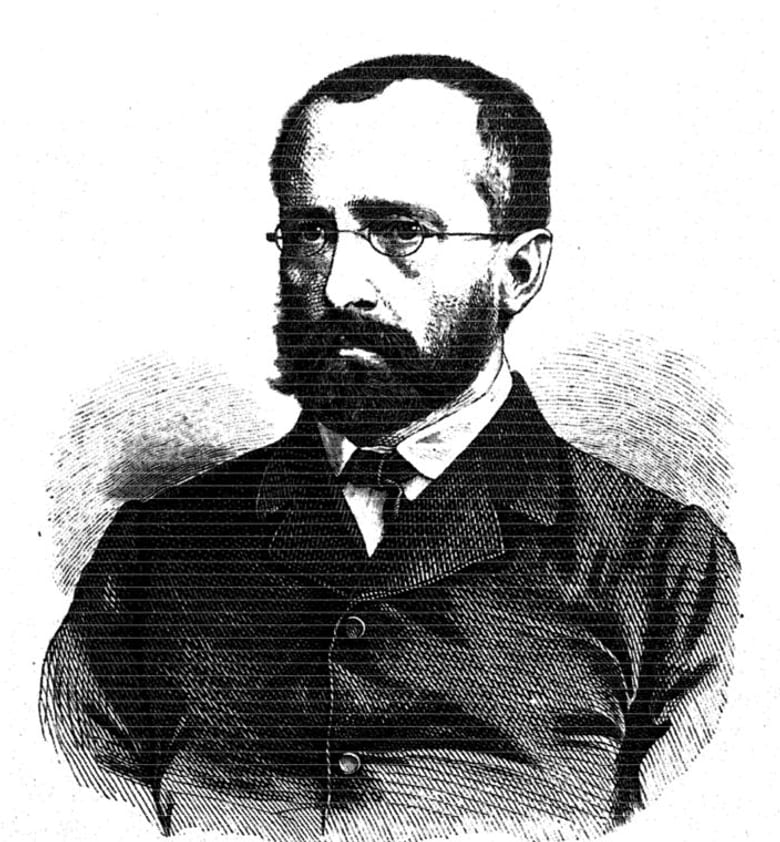
The Bopp feature on this site ended with a warning: the metaphor “language is an organism” would grow, in later hands, into something more dangerous. August Schleicher (1821–1868) is the figure most responsible for that turn.
From botanist to linguist
Schleicher trained first in theology before turning to linguistics, but he remained a dedicated amateur botanist for his whole life. After a period at Prague, he became a professor at the University of Jena in 1857. This background is not incidental — he brought the eye of a natural scientist, trained on classifying plant and animal species and diagramming their genealogical relationships, directly into the comparison of languages. The book this feature reads, the Compendium der vergleichenden Grammatik der indogermanischen Sprachen (Compendium of the Comparative Grammar of the Indo-European Languages), was published in 1861, the distillation of fifteen years of lecturing.
Written as a practical textbook for students
In his preface, Schleicher explains how the book came to be: tired of forcing both himself and his students through the drudgery of copying material onto the blackboard lecture after lecture, he first had students transcribe his lecture notes, and these gradually grew into a printed textbook. This was written not as a polemic among specialists, but as a practical handbook for beginners — and that fact matters for understanding the book’s character. Because of it, Schleicher states his own theories not as hedged, cautious claims but as terse, confident assertions. That bluntness is exactly what makes his thinking so easy to see clearly.
The map of this feature
The next two articles introduce, without jargon, Schleicher’s two central claims: his flat assertion that language “lives” but has no “history,” and his framework of language history not as progress but as development followed by decay. The two after that give a close reading of both claims in the original German. From there we trace the throughline from Bopp, an unexpected connection to the Müller and Jespersen features, and close with an assessment from nearly two centuries later.
Summary
| Point | Detail |
|---|---|
| Who | August Schleicher (1821–1868, Germany, Professor at Jena) |
| Landmark work | Compendium der vergleichenden Grammatik der indogermanischen Sprachen (1861) |
| Also known as | A lifelong amateur botanist |
| The book’s place | A practical student textbook grown from fifteen years of lecture notes |
In a nutshell — where Bopp spoke of “language as an organism” as a metaphor, Schleicher took it literally. This feature reads that turning point.
