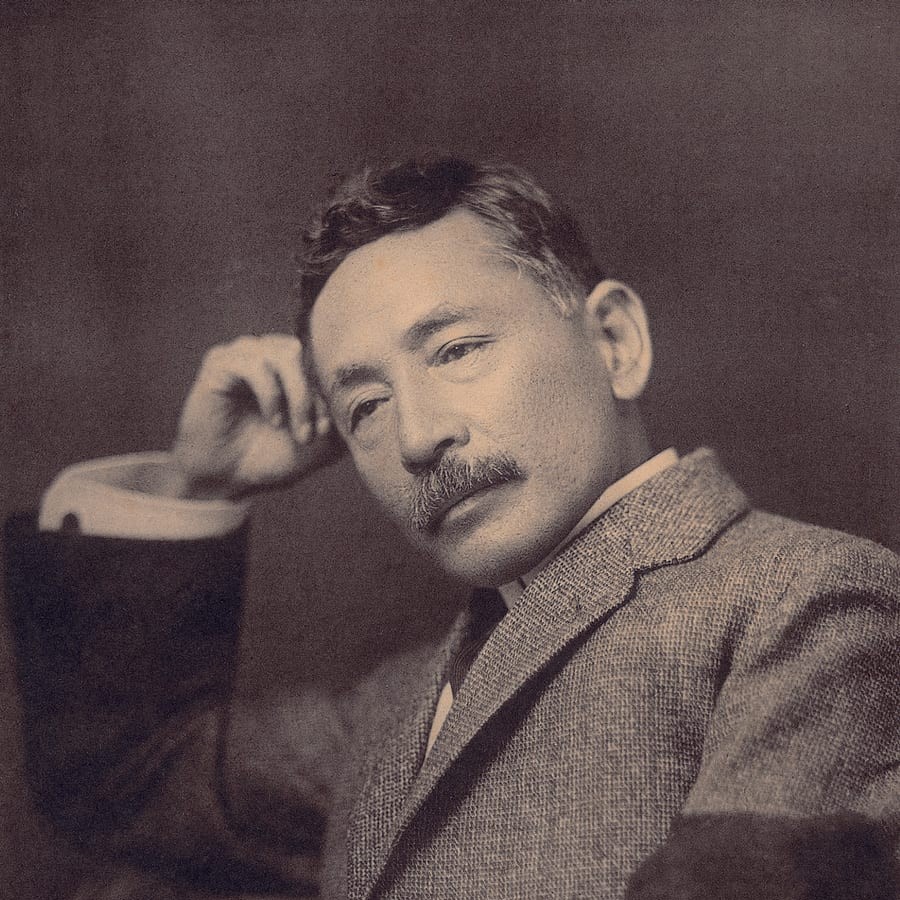
My Individualism
A rakugo punchline about grilled fish, a fog-bound sack, a brother dragged out fishing, a tofu seller. Reading the 1914 lecture Natsume Sōseki gave at the Peers' School, in the original — self-reliance, the ethics of power and money, and freedom bound to duty.
Reading "My Individualism" — A Lecture That Opens with a Fish Joke
In 1914, at the Peers' School, Natsume Sōseki opened his lecture with a rakugo punchline about grilled fish, then told his own story of failure, and built up a theory of individualism out of the words power, money, duty, and freedom. Seven articles, starting with the map.
Alone Inside a Sack — Self-Reliance, and a Single Pickaxe
Three years majoring in English literature, and he still can't say what literature is. In London, it feels like being shut inside fog, staring blankly in every direction. Sōseki speaks with real candor about the road from that "anguish" to the four characters of "self-reliance."
The Brother Who Drags His Sibling Fishing — Why Power and Money Are Dangerous
A brother who loves fishing drags his stay-at-home sibling out to the fishing pond against his will. From this small domestic scene, Sōseki works out the danger of power and money — tools for forcing one's own individuality onto someone else.
Freedom Without Duty Is Not Freedom — The Loneliness of Individualism
"England expects every man to do his duty." Sōseki notices that England, a country that prizes freedom, is at the same time a country of remarkable order. From there he defines individualism as the opposite of factionalism — and admits it carries a certain loneliness, illustrated by an incident involving the critic Setsurei Miyake.
The Tofu Seller Doesn't Sell Tofu for the Nation — Individualism and Nationalism
A tofu seller walks the streets selling tofu not for the sake of the nation, but to earn a living. Sōseki uses this blunt, unglamorous example to show that individualism is not the opposite of nationalism — reading it alongside a story from his own days at a Kumamoto high school.
Close Reading — Fog, Sack, Awl, Pickaxe, Vein of Ore: One Metaphor Growing Up
Sōseki doesn't push through his anguish with a single fixed image. He follows fog into a sack, an awl into a pickaxe, and finally into a vein of ore — tracing, in the original text, the order in which one metaphor keeps changing shape.
Verdict — Does "My Individualism" Still Hold Up Today?
Self-reliance, duty, respect for others' individuality. Which parts of Sōseki's argument still stand as-is today, and which carry assumptions specific to the Peers' School audience of 1914? A final assessment after seven articles.