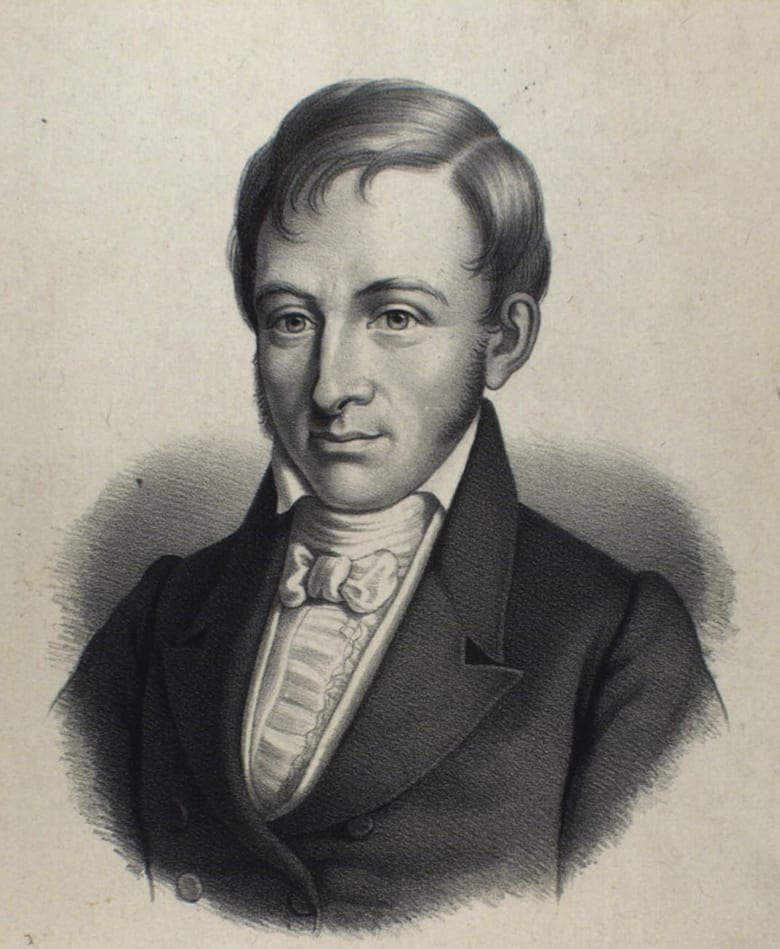
Rasmus Rask
A traveling Danish linguist who established the method of comparative linguistics four years before Grimm's table. Reading, from the original Danish, the prize essay Investigation Concerning the Origin of the Old Norse or Icelandic Language (1818) — from "look at grammar, not vocabulary" to why his name didn't stick.
Reading Rasmus Rask's Investigation Concerning the Origin of the Old Norse or Icelandic Language (1818) — the Man Who Established the Method of Comparative Linguistics Four Years Before Grimm
Written for a prize competition of the Royal Danish Society of Sciences. Four years before Grimm's famous table appeared, Rask had already stated, in his own words, the principle that grammar is a far more reliable guide than vocabulary.
Look at Grammar, Not Vocabulary — Rask's Method, Simply
Don't judge whether two languages are related just by how similar their words sound — in 1818, Rask took that intuition and, with a clear argument behind it, turned it into a method for linguistics. No jargon — just the reasoning itself.
The Traveling Linguist — Rasmus Rask's Short, Eventful Life
After finishing his prize essay at twenty-seven, Rask left Europe behind and traveled through Russia and Persia all the way to India and Ceylon. Not a scholar of the study, but a researcher who kept collecting words and manuscripts in the field — tracing a life of forty-four years.
"Etymology Has Been a Playground for Whimsy" — Reading Rask's 1818 Original Closely
The Danish-language opening of Chapter I begins with a sharp attack on the etymology that came before it. Tracing Rask's argument, step by step, from that opening through to the concrete rule of thumb that a more complex grammar means an older language — from the original text.
Similar Doesn't Mean Safe — Reading Rask's Comparative Practice
Greek πατήρ, Latin pater, German Vater, Icelandic faðir — the word for "father." Similarity alone shouldn't be enough to conclude a shared ancestor, and Rask applied that caution even to his own best examples. Then comes an unexpected starting point: "first, compare it with Greenlandic."
Why "Grimm's Law," and Not "Rask's Law"?
Rask reached the same discovery first. So why did the name that survived into posterity belong to Grimm? Reading the wall of the Danish language, and the power of systematization.
Verdict — How Rask's Method Looks Two Centuries Later
"Grammar over vocabulary" remains a foundation of comparative linguistics to this day. But one of Rask's own specific judgment calls — that Celtic didn't belong to the family — was wrong. Grading the correctness of the method separately from the correctness of any one conclusion.