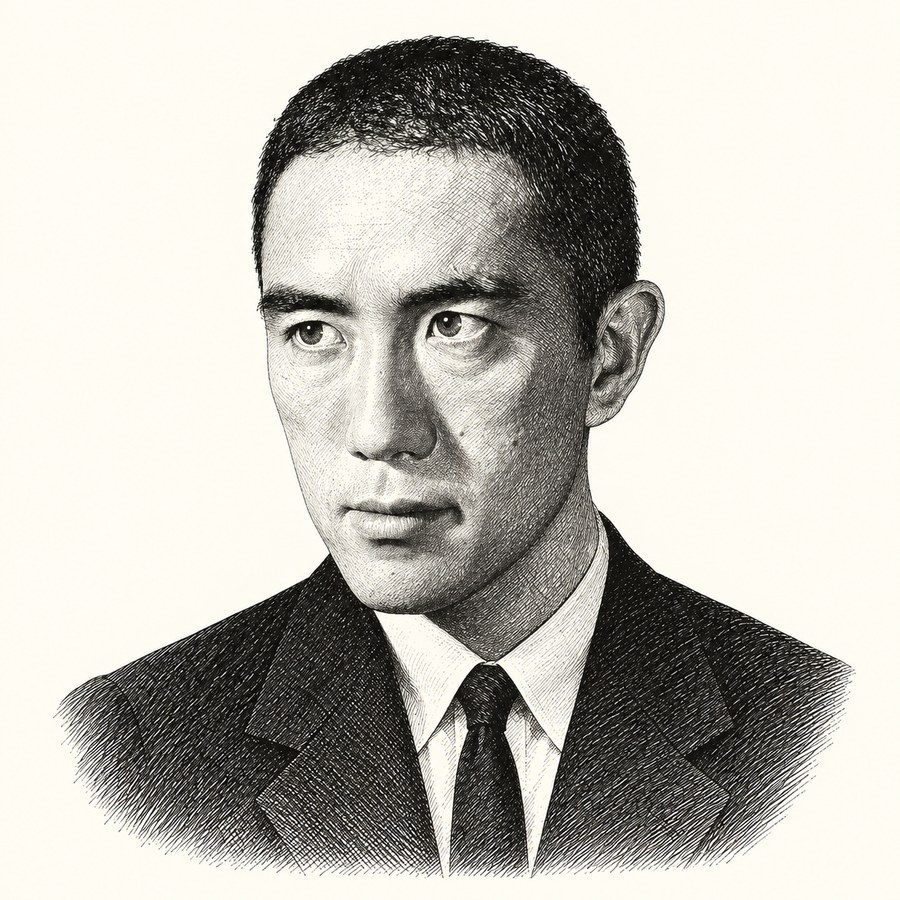
Bunshō Tokuhon 2: Varieties of Prose
Kanji as men's script, kana as women's script. A language without alliteration builds its rhythm through the Man'yōshū's pillow words and the 7-5 meter. What Futabatei Shimei cut off. And modern readers who read novels as if driving a car. Reading Chapter 2, "Varieties of Prose," in the original.
Reading "Varieties of Prose" — Men's Script and Women's Script, Verse and Prose, and the Habit of Savoring
Mishima Yukio looks at the character of Japanese prose through four windows: the division of labor between kana and kanji by gender, the history of verse and prose, the break after Futabatei Shimei, and the change in how modern people savor prose. A sketch of the longest chapter in the book, about 22,000 characters.
Kanji as Men's Script, Kana as Women's Script — The Division of Logic and Feeling by Gender
In the Heian period, kanji was called men's script, kana women's script. The author of the Tosa Diary disguised himself as a woman to write in women's script. Mishima Yukio sees, behind this division, a history in which logic and intellect were entirely entrusted to foreign thought.
A Language Without Alliteration Finds a Way — From the Man'yōshū's Pillow Words to Modern Ad Slogans
Japanese has neither alliteration nor rhyme. Even so, the Man'yōshū tried, with pillow words, for an effect like alliteration. The thirty-one syllables of 5-7-5-7-7 became "the golden ratio of Japanese," and the 7-5 meter tradition still lives in "one sneeze, three Lulu tablets."
What Futabatei Shimei Cut Off — Higuchi Ichiyō Became a Classic, and a Century of Translationese
After Futabatei Shimei, Japanese prose underwent a revolutionary change. Higuchi Ichiyō and Ozaki Kōyō alike became classical literature. At the same time, translated style worked its way into Japanese itself. We read Mishima Yukio's view of the break and the continuity in style.
Prose You Walk, and Prose You Savor — From "Shall I Do Some Reading Now" to the Age of the Weekly Magazine
The samurai of kabuki reads a book unhurriedly. Today's weekly magazine is fated to be thrown away. Mishima Yukio contrasts modern people, who read novels as if driving a car, with the readers of old, who savored prose as if taking in the scenery one thing at a time — and closes the chapter.
Close Reading — "Abstract Concepts Were Substituted by German-Idealist Terms" — One Claim, Read from Two Places
In "Men's Script and Women's Script" and "The Habit of Savoring Prose," two sections far apart, Mishima Yukio repeats the same claim — that Japan's abstract concepts are foreign in origin. We set the two originals side by side and check both the substance of this claim and its limits.
Legacy and Verdict — The 7-5 Meter Survived; "Japanese Has No Abstract Concepts" Stays Mishima's Own Essay
The observation that the 7-5 meter lives on in modern slogans is still easy to confirm today. The claim that "Japan's abstract concepts cannot achieve clarity," on the other hand, was never proven linguistics — it should be read as Mishima's own essay. We grade the four sections of Chapter 2 separately.