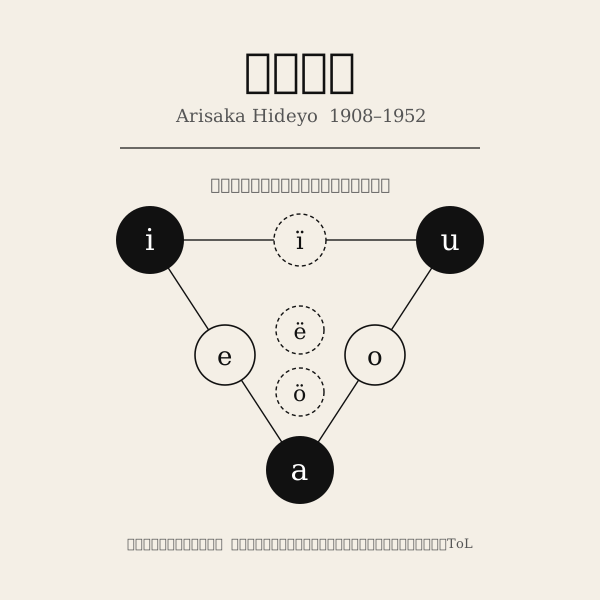
Arisaka Hideyo
Did Nara-period Japanese have eight vowels? Closing in on the identity of the two man'yōgana groups Hashimoto Shinkichi found, and asking whether the sound of "n" (ん) is really one sound, Arisaka Hideyo rebuilt what a "sound" is. Reading Arisaka's Law and Onin-ron (1940).
Reading Arisaka Hideyo — Did Nara-Period Japanese Have Eight Vowels?
The two groups of man'yōgana that Hashimoto Shinkichi found — what was the difference between them? Arisaka Hideyo (1908–1952) approached the answer through a law hidden in how vowels combine within words, and then, in Onin-ron (1940), rebuilt the very question of what a "sound" is.
Five Vowels Become Eight — Where the A/B Difference Shows Up
The A/B sorting of man'yōgana that Hashimoto Shinkichi found appears only in the family of ki, ke, and ko — never in the family of ka or ku. That lopsidedness became the first clue that the difference between the two sounds lay in the vowel. Following, without jargon, how five becomes eight.
What Is Arisaka's Law? — Some Vowels Never Share a Word
Inside a single word of Nara-period Japanese, certain combinations of vowels never sat together. That regularity became strong evidence that the A/B difference was a difference in vowels. An introduction, with as little jargon as possible, to the law Arisaka Hideyo found.
Is the Sound of "n" (ん) Really One Sound? — Phonetic Sound Versus Phoneme
The "n" (ん) in hon, sanma, and sankaku is in fact different each time — in mouth shape and tongue position alike. Yet we feel all of them to be the same "n." Arisaka Hideyo's Onin-ron (1940) asked again what lies behind this "sameness" felt by ear, calling it the "phoneme."
Close Reading — "A Phoneme Should Rather Be Compared to the Currency Itself" — Where He Disagrees With Saussure
Saussure compared the sounds of a language to the "value" of a currency. Arisaka Hideyo objects, and re-compares them to "the currency itself." Why does a worn coin still pass as that coin? Reading Part 1 of Onin-ron (1940) in the original.
Close Reading — "We Received a Ready-Made Phonemic System From Our Parents" — Who Made the Phonemic System?
The sound distinctions of Japanese are not something we made because we needed them. Our ancestors made them, and we merely inherited them. Arguing head-on with the Prague School's Trubetzkoy, Arisaka Hideyo uses the analogy of a sweet to describe what a phonemic system is. Reading Part 1 of Onin-ron (1940) in the original.
Legacy and Verdict — Arisaka's Law Holds, the Eight Vowels Remain Debated, and Onin-ron Lives On as a Question
Arisaka Hideyo's work is assessed differently on three layers. The regularity in vowels within words (Arisaka's Law) became a foundation of ancient-Japanese research. The eight-vowel theory is leading but unsettled. And Onin-ron lives on not as an answer but as a way of posing the question "what is a sound?"