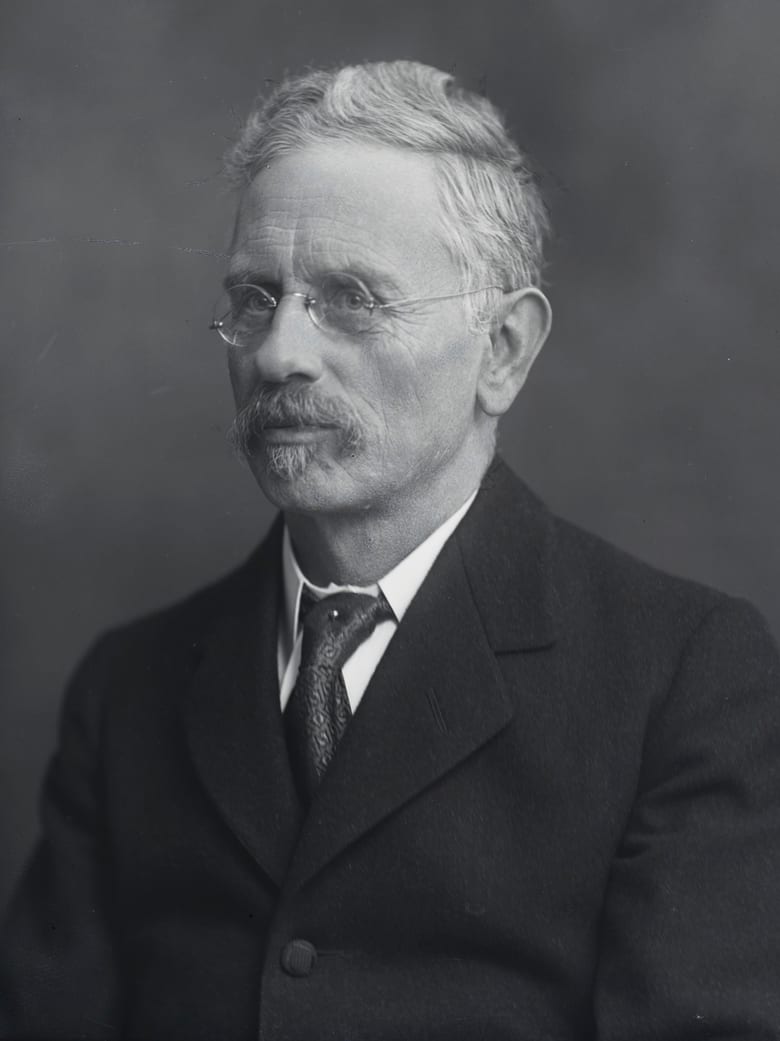
William Jones, Jacob Grimm, Max Müller — the three figures this feature has read so far were each built around one discovery, one law, one lecture series. Otto Jespersen (1860–1943) belongs to the next generation that inherited all of it. A professor of English at the University of Copenhagen, past sixty when he wrote it, Jespersen produced the book this feature now reads: Language: Its Nature, Development and Origin (1922).
A scholar of English, and the designer of an international language
Jespersen held the chair of English at the University of Copenhagen and left dozens of books over his career, including the seven-volume A Modern English Grammar on Historical Principles. He also invested heavily in phonetics pedagogy, championing what would later be called the “direct method” of practical classroom language teaching. Late in life, in 1928, he even designed his own international auxiliary language, “Novial,” in the tradition of Esperanto — not just a scholar of language, but someone who built a new one himself, an unusual path for a linguist of his era.
The work of gathering it all into one book
Language is a substantial volume of four parts spanning twenty-one chapters.
- Book I, “History of Linguistic Science” — surveys the discipline’s development from before 1800 through the end of the nineteenth century, including the work of Jones, Grimm, and Müller read elsewhere in this feature.
- Book II, “The Child” — examines how children acquire their native language, in sound, vocabulary, and grammar.
- Book III, “The Individual and the World” — covers the points where language meets society: the foreign learner, pidgin languages, and “the woman.”
- Book IV, “Development of Language” — etymology, whether language is progressing or decaying, the origin of grammatical elements, and finally the largest question of all: the origin of speech itself.
Gathering up what nineteenth-century comparative linguistics had accumulated, one writer assembled it into a single volume a general reader could follow — that is Language’s place in the field. Call it a book of synthesis and assessment, rather than of new discovery.
Map of this feature
The next two articles introduce, in plain language, Jespersen’s provocative claim that “language is progressing,” and his pioneering observations on how children acquire language. The two after that offer a close reading of his surprisingly even-handed look at pidgin languages and his survey of theories on the origin of speech. This feature’s heaviest subject is the chapter on “The Woman” — where claims that are plainly indefensible by today’s standards are argued at full confidence. It closes with an article grading all of it from a distance of nearly two centuries.
Summary
| Point | Content |
|---|---|
| Who | Otto Jespersen (1860–1943), University of Copenhagen, Denmark |
| Major work | Language: Its Nature, Development and Origin (1922) |
| The book’s place | A synthesis of nineteenth-century comparative linguistics’ achievements |
| Another side | Designer of the international auxiliary language “Novial” (1928) |
In a nutshell — Jespersen took up what Jones, Grimm, and Müller had built, added new questions about the child, pidgin languages, and the origin of speech, and gathered it all into a single book.
