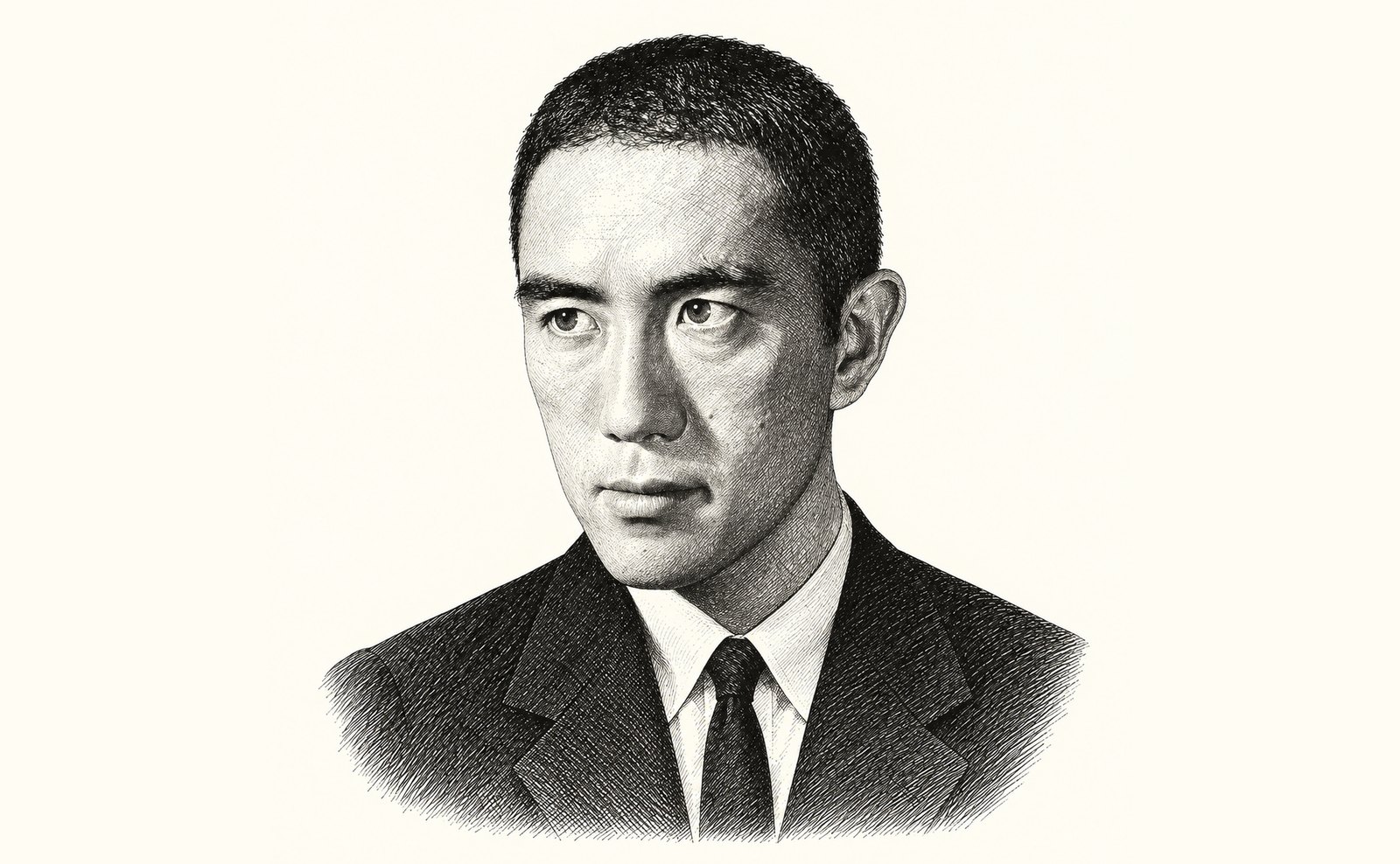
Seeing the title “Bunshō Tokuhon,” one thinks of a book that teaches how to write. But Mishima Yukio’s (1925–1970) Bunshō Tokuhon is not that. It is written from the reader’s side. In this first article of the feature, we check its whole shape by size and structure. (English renderings of the quotations are ToL translations.)
About the book
Bunshō Tokuhon appeared in January 1959 (Shōwa 34) as a supplement to the magazine Fujin Kōron, and was published as a book by Chūō Kōron-sha in June of the same year. (This account is from Noguchi Takehiko’s afterword in the same volume.) In this feature we use the Chūkō Bunko new edition (Chūō Kōron Shinsha). Page numbers below are from that edition.
A “reader” written from the reading side
In the first chapter, Mishima clearly limits the purpose of the book.
私はここでこの「文章読本」の目的を、読む側からの「文章読本」という点だけに限定した方が、目的も明確になり、素人文学に対する迷いを覚ますことにもなると思うのです。(p.10)
(I think that if I limit the purpose of this “Bunshō Tokuhon” here to being a “Bunshō Tokuhon” from the reading side, the purpose becomes clearer, and it will also dispel confusion about amateur literature.)
So this is not a book that teaches “prose anyone can write.” Mishima writes that he feels bitter about such tendencies (Chapter 1). What the book aims at is leading readers of fiction from the lecteur (ordinary reader) to the liseur (attentive reader). We look at this distinction in detail in the next article.
Eight chapters and an appendix
The book consists of eight chapters and an appendix of questions and answers.
| Chapter | Title | Content |
|---|---|---|
| 1 | The purpose of this bunshō tokuhon | Leading readers to be “attentive readers.” Practical prose and prose for appreciation |
| 2 | Varieties of prose | Men’s script and women’s script, prose and verse, the historical change of prose aesthetics, the habit of savoring prose |
| 3 | The prose of fiction | Two kinds of models, prose of the short story, prose of the long novel |
| 4 | The prose of drama | Dialogue in fiction versus dialogue in drama, the style of drama |
| 5 | The prose of criticism | Critical prose, the logic of Japanese |
| 6 | The prose of translation | Two attitudes to translation, the cultivation to read translated prose |
| 7 | Techniques of prose | Depiction of persons (appearance, dress), of nature, of psychology, of action; grammar and technique |
| 8 | Prose in practice — conclusion | The author’s own practice. Dignity and grace |
| Appendix | Questions and answers | Answers to fifteen questions |
By size
Where does the weight of the book lie? Let us compare the chapters by the approximate character counts of the body text extracted by OCR.
Chapter 2 (about 22,000 characters), Chapter 3 (about 21,000), and Chapter 7 (about 31,000) together make about sixty percent of the body. That this group of features centers on these three chapters has a reason in size as well.
Three attitudes of the book
Read through, three attitudes of Mishima’s appear.
One: making attentive readers. The aim of the book is to lead readers to be people who savor fiction deeply.
Two: not making one type supreme. Mishima says he is “not trying to build a class system of styles, dogmatically taking one type of style as the best,” and adds:
私はなるたけ自分の好みや偏見を去って、あらゆる様式の文章の面白さを認め、あらゆる様式の文章の美しさに敏感でありたいと思います。(p.13)
(I want, as far as possible, to set aside my own tastes and prejudices, to recognize the interest of every style of prose, and to be sensitive to the beauty of every style.)
Three: setting out examples for savoring. Rather than abstract theory of prose, Mishima cites many concrete passages and has the reader savor them. In Chapter 3, as “two kinds of models,” a passage of Mori Ōgai and a passage of Izumi Kyōka are set side by side. We read this point in detail in the Chapter 3 feature.
How to read this book
The book is the view of one novelist in 1959. One need not always agree with Mishima’s assertions. Still, it can be read both as material for how a leading writer of the time saw prose, and as a guide for cultivating an eye to savor prose.
In the second half of this series (features 5–8), we read Mishima’s own works and see how the ideas voiced in this book appear in them. As the bridge, we first look at this book in detail.
Structure of this feature
| Article | Content |
|---|---|
| 1 (this one) | The whole book |
| 2 | Chapter 1: the lecteur and the liseur |
| 3 | Chapter 4: the prose of drama |
| 4 | Chapters 5 and 6: criticism and translation |
| 5 | Chapter 8: the writer’s practice, and dignity and grace |
| 6 | Appendix: questions and answers |
| 7 | How to read this book, and its limits |
Summary
| Point | Detail |
|---|---|
| Making of the book | January 1959 as a supplement to Fujin Kōron; June of the same year as a book from Chūō Kōron-sha |
| Purpose | A “reader” from the reading side. Leading readers to be “attentive readers” |
| Structure | Eight chapters and an appendix. Chapters 2, 3, 7 are about sixty percent of the body |
| Attitudes | Make attentive readers / no supreme type / set out examples for savoring |
In a nutshell — Bunshō Tokuhon is a guide, written by a writer for readers, to how to savor prose. Its weight lies in Chapters 2, 3, and 7.