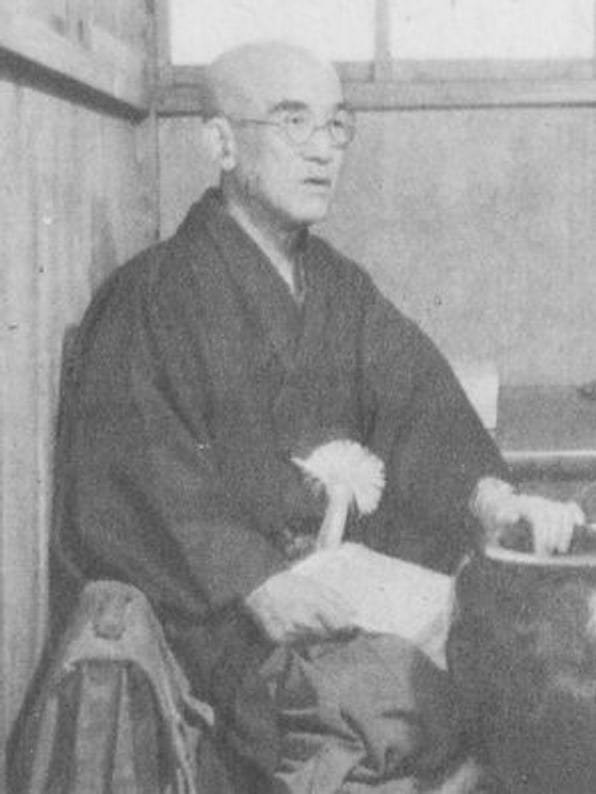
Kanazawa Shōzaburō (1872–1967) was a linguist of the generation taught by Ueda Kazutoshi, and translated Sayce’s Language (1898) together with Ueda. He is also known as the editor of the dictionary Jirin (1907). What we read in this feature is what Kanazawa wrote in exploring how individual words of Japanese were made.
Kanazawa’s method
Kanazawa’s hallmark is that he doesn’t explain Japanese words from within Japanese alone but compares them with surrounding languages. By setting them beside Korean, Ainu, the dialects of the Ryukyus (Okinawa), and Sanskrit, he thought, an old shape of Japanese comes into view.
Within that comparison, Kanazawa put forward the theory that Japanese and Korean originally belong to the same family (the Japanese–Korean kinship theory). The theory was a scholarly claim, and at the same time deeply bound to the politics of the age in which it was spoken. This feature checks both sides in the original.
What this feature reads
From Kokugo no kenkyū (1910), we read stories of three words and two passages in the original.
- Tachi, kumoru, kubiru — how names of things are turned into names of actions. (Plain-language explainer 1)
- The “na” of namida — Kanazawa’s view that it may be an old word for “eye.” (Plain-language explainer 2)
- East, west, south, north — the several theories on where direction names came from. (Plain-language explainer 3)
- Close reading of “Jimoku-bikō” — the way of comparing with Korean, and its conclusion. (Close reading 1)
- Close reading of “Chōsen ni okeru kokugo mondai” — what the same Kanazawa wrote on a political occasion. (Close reading 2)
Finally, we sort out how each is treated now, in the verdict article.
A caveat up front
Many of Kanazawa’s etymologies rest on comparison with Korean and other languages, and the premise of that comparison — that Japanese and Korean are related — has not been proved in linguistics today. Kanazawa’s Japanese–Korean kinship theory is also pointed out to have been politically used in later times. This feature does not present Kanazawa’s theories as correct; it checks in the original what Kanazawa observed and where he himself marked conjecture, and in what age the theories were spoken. The “present treatment” in the verdict article is a generally known summary of Japanese linguistics, not a check of individual papers.
Summary
| Point | Detail |
|---|---|
| Who | Kanazawa Shōzaburō (1872–1967, linguist, editor of Jirin) |
| Primary source | Kokugo no kenkyū (1910) (freely viewable at the National Diet Library) |
| Method | Explore Japanese words by comparing them with Korean, Ainu, Ryukyuan dialects, and Sanskrit |
| Caution | The Japanese–Korean kinship theory is unproved and was also politically used; read the theory and the age separately |
In a nutshell — Kanazawa Shōzaburō explored familiar words like namida and nishi by comparing them with surrounding languages. As scholarship the comparison remained unproved, and it also became bound up with the politics of its time. We check both in the original.
.jpg)