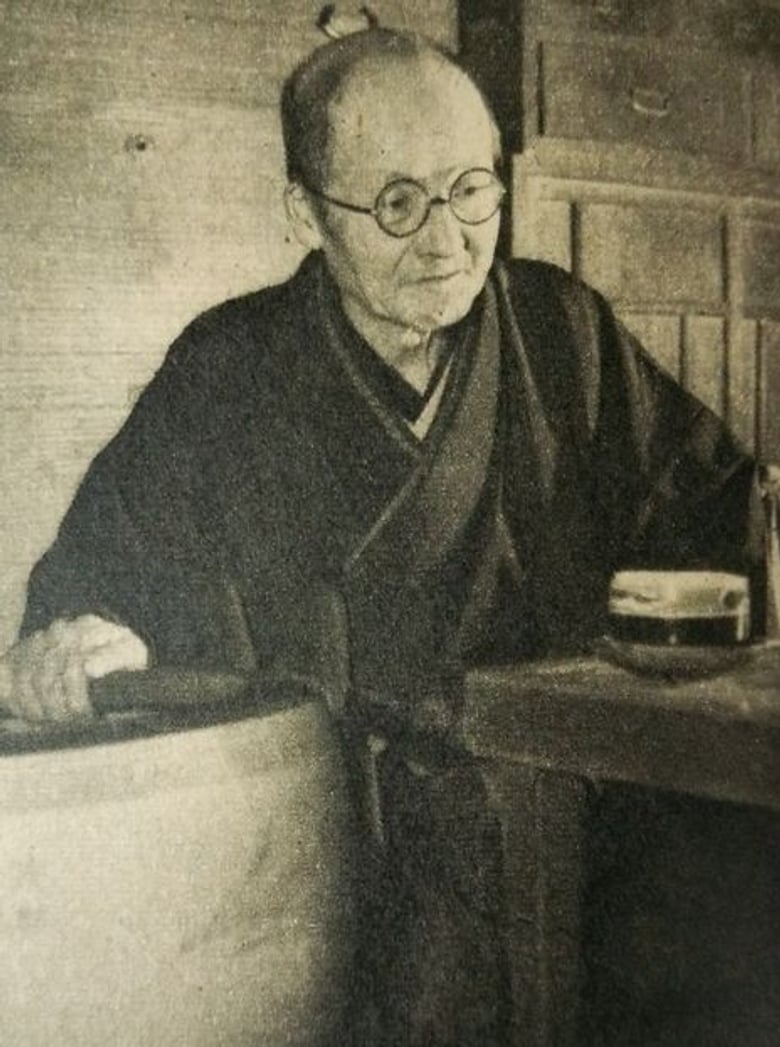
Yamada Yoshio
A self-taught scholar cuts down nearly every grammarian from the Edo to Meiji eras, by name, before stating his own theory. Where does the difference between "the flower blooms" and "does the flower bloom?" actually come from? Reading Nihon Bunpōron (1908), and its theories of chinjutsu and kakari-musubi — the mechanics of the Japanese sentence itself.
Reading Yamada Yoshio's Nihon Bunpōron (1908) — The Man Who Cut Down Every Predecessor Before Making His Own Case
Fujitani Nariakira, Motoori Norinaga, Suzuki Akira, Ōtsuki Fumihiko — Yamada examines nearly every grammarian from the Edo period to the Meiji era, by name, one after another, before he finally states his own theory. Reading a nearly two-thousand-page book through its sheer thoroughness.
What Is Chinjutsu Theory? — A Japanese Sentence Doesn't Decide What It's Doing Until It's Finished
"The flower blooms." "Does the flower bloom?" "Flower, bloom!" — nearly the same words, but changing only the ending turns a report into a question, into a command. The mechanism Yamada Yoshio named "chinjutsu" — what makes a Japanese sentence a sentence.
What Is Kakari-Musubi? — An Agreement Rule, Unique to Classical Japanese, That Reaches Across a Sentence
Add a single particle in the middle of a classical Japanese sentence, and the inflected form far away at its end changes. A strange mechanism, found nowhere in modern Japanese, that once linked one point in a sentence to another.
Close Reading — "A Unified Thought Is One Unified by a Single Act of Apperception": Chinjutsu Theory in the Original
What is a sentence? Yamada Yoshio builds his explanation around "apperception" (tōkaku sayō), a concept borrowed from Wundt's psychology, to explain how a single thought comes to hold together as one "sentence." Reading the core of Part II, "Sentence Theory," in the original.
Close Reading — "What Has Traditionally Been Called a Kakari-Shi": A Dialogue With Predecessors Over the Kakari Particle
Before the mechanism of kakari-musubi itself, Yamada first examines who called it what. Motoori Norinaga, Fujitani Nariakira — reading, in the original, the history behind a single word: "kakaru" (to link).
Legacy — The Word "Chinjutsu" Survived; Yamada's Own Grammar Never Made It Into Schools
The term "chinjutsu," which Yamada coined, remains a basic word in Japanese grammatical study today. But the grammar taught in schools — the one that breaks sentences into "bunsetsu" units — wasn't built by Yamada. It was built by the next generation's Hashimoto Shinkichi.
Verdict — How Nihon Bunpōron Looks From More Than a Century Later
The idea of chinjutsu — the insight that a sentence isn't complete until it's finished — is still alive today. But the part explaining that mechanism through German psychology's "apperception" has been rewritten, again and again, by later researchers. Grading a project that began with no model to follow.