Matsushita Daizaburō
The particles "o," "ni," and "tari" are not words. "Gakusei-rashii" is one word made of three parts. A grammarian who removed particles and auxiliaries from the parts of speech and gave "formal nouns" a place among the nouns. Reading Hyōjun Nihon Bunpō (1924) in the original.
Reading Matsushita Daizaburō — The Man Who Treated "Hana o" and "Tsuki ni" as Single Words and Rebuilt Japanese Grammar from Zero
The particles "o," "ni," and "tari" are not words. "Gakusei-rashii" is one word made of three parts. Matsushita Daizaburō (1878–1935) built Japanese grammar from a starting point entirely different from what is taught in school. We read the outline of his Hyōjun Nihon Bunpō (1924) in his own terms.
"Hana o" Is One Word, "o" Is a Part — Dividing Language into Three Steps
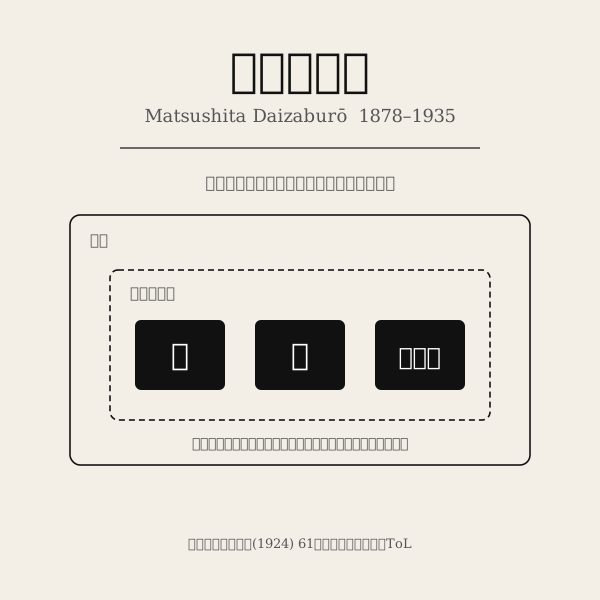
A sentence is made of words in a row. Matsushita Daizaburō did not think so. Language has three steps: the unit of utterance (danku), the word (nenshi), and the parts of a word (genji). Why are "hana o," "tsuki ni," and "sakitari" each one word?
Nine Parts of Speech Became Five — Particles and Auxiliaries Are "Shoes"
The parts of speech taught in school number about ten: noun, verb, adjective, particle, auxiliary verb, and so on. Matsushita Daizaburō made them five. Particles and auxiliaries fall outside the parts of speech. His reason is explained through the image of a person and shoes.
Is the "Kore" of "Kore, Nani o Suru" a Pronoun or an Interjection? — Words of Intuition and Words of Concept
We learn that "kore" is a pronoun, standing in for a name. But when someone says "Kore, nani o suru," is that "kore" standing in for anything? Matsushita Daizaburō says pronouns easily turn into interjections. Behind it lay a distinctive idea of dividing words into "intuition" and "concept."
Close Reading — "Gakusei-rashii" Is One Word Made of Three Genji — The Opening of the Theory of Elements
"Yama" can be a word by itself. But the Sino-Japanese "san" (mountain) cannot. Neither can "o" or "ni." Matsushita Daizaburō called the parts of words "genji" and made the rules of how they combine one pillar of grammar. We read the general remarks of Part 2, "Genji-ron," in the original.
Close Reading — "Mono," "Koto," "Hazu," "Tame" — Formal Nouns, in a Threefold Division of the Noun
What does the "hazu" of "shirazaru hazu nashi" point to? Or the "mono" of "kitaru mono wa kobamazu"? Matsushita Daizaburō divided nouns into three — true nouns, pronouns, and formal nouns — and gave a clear place, under the name "formal noun," to nouns whose meaning has drained away and only form remains. We read that passage of Part 3 in the original.
Legacy and Verdict — "Formal Noun" Survived; "Particles Are Not Words" Stayed a Minority View
The term "formal noun" is still used ordinarily today. On the other hand, the five parts of speech that removed particles and auxiliaries were not adopted by school grammar. We grade Matsushita Daizaburō's work in three parts: terminology, how units are cut, and parts of speech.