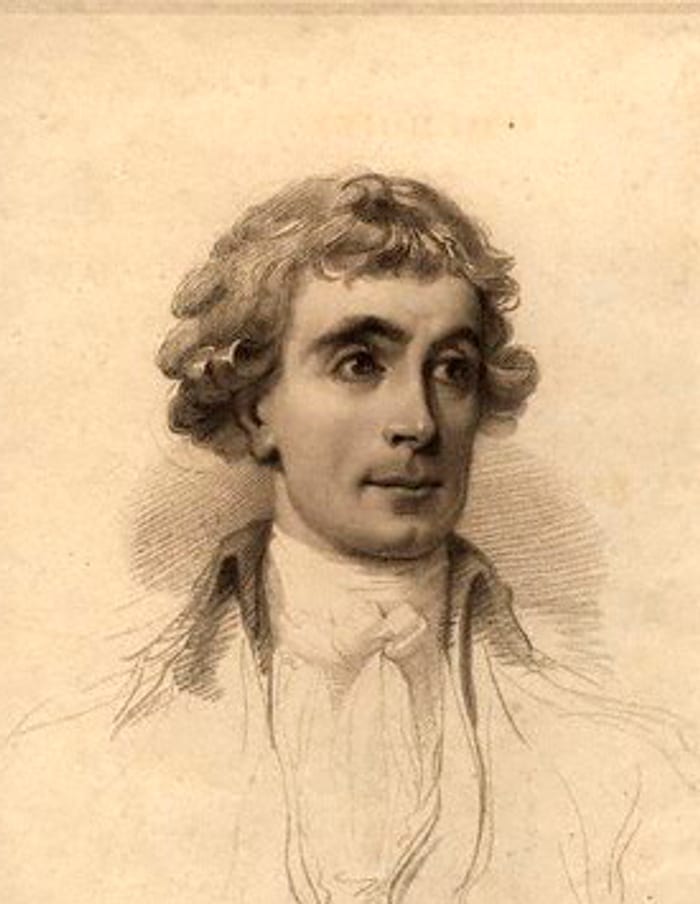
Calcutta, 2 February 1786. An English judge named William Jones (1746–1794) rose to give the annual address to a scholarly society he had founded himself — the Asiatic Society. What he’d prepared was a long survey of Indian history, religion, language, architecture, and learning — later known as “The Third Anniversary Discourse.” Partway through, a single paragraph on language became the starting point for comparative linguistics, and for the entire idea of an “Indo-European” language family.
A judge who was also a linguistic prodigy
Jones was born in London and went from Harrow School to University College, Oxford, where he studied Latin, Greek, Hebrew, Arabic, and Persian. Over his lifetime he is said to have learned twenty-eight languages, many of them self-taught. His Grammar of the Persian Language (1771) served as the standard textbook in the field for decades. Scholarship alone didn’t pay the bills, though, and in 1774 he qualified as a barrister. Knighted in 1783, he sailed for Calcutta as a judge of the supreme court. In January of the following year, he founded a learned society dedicated to Oriental studies — the Asiatic Society of Bengal — and became its first president.
Barely two years after arriving, on 2 February 1786, he delivered the annual address this article covers — “The Third Anniversary Discourse.” That he could build an argument of this reach so soon after taking office owes everything to the linguistic groundwork laid at Oxford and the reputation he had already built as an Orientalist.
(Japanese and English renderings of quotations throughout are ToL’s own.) His interest in Sanskrit wasn’t purely academic, either. As a judge, he was planning a massive digest that would systematize Hindu and Muslim law for incorporation into the English-language legal system — and that meant reading the sources himself. One of the most influential discoveries in the history of linguistics grew out of a practical motive tied to colonial administration. Worth keeping in mind for everything that follows. Sanskrit was still, at the time, largely unknown to Europe — vanishingly few Europeans before Jones had studied it seriously, and reading the Vedas or classical literature in the original meant working through a local pandit as intermediary. As a judge, Jones found himself in the rare position of having both direct access to those very texts and a practical need to read them himself.
Four windows — the shape of the discourse
After lamenting how hard it is to know India’s ancient history — the Greeks who entered India with Alexander, he notes, left almost no accurate record of the vernacular languages they encountered — Jones lays out his own roadmap. There are, he says, only four general means of satisfying this curiosity: languages and letters; philosophy and religion; the surviving remains of sculpture and architecture; and the written memorials of the sciences and arts. The discourse then proceeds, as promised, through each pillar in turn. The famous paragraph sits inside the section covering the first of these — “Languages and Letters.”
“Could not possibly have been produced by accident” — the paragraph itself
In that first section, Jones opens by discussing the relationship between Hindi and Sanskrit. A conqueror’s language, he observes, typically leaves only vocabulary behind in the conquered people’s speech — as Turkish did in Greece, or Saxon in Britain — while the underlying grammar survives untouched. On this reasoning, spoken Hindi, though it borrows freely from Sanskrit, might carry a grammatical skeleton of altogether separate origin. This care in distinguishing borrowed vocabulary from inherited grammatical structure sets up the paragraph that follows. Right after finishing with Hindi, Jones continues:
The Sanscrit language, whatever be its antiquity, is of a wonderful structure; more perfect than the Greek, more copious than the Latin, and more exquisitely refined than either; yet bearing to both of them a stronger affinity, both in the roots of verbs, and in the forms of grammar, than could possibly have been produced by accident; so strong, indeed, that no philologer could examine them all three without believing them to have sprung from some common source, which, perhaps, no longer exists.
He goes on to add that Gothic (an old Germanic language) and Celtic likely share the same origin, and that Old Persian might belong to the same family as well. An “affinity” too strong to have arisen by accident is evidence of a common ancestor — that single logical move is, in essence, the founding gesture of comparative linguistics as a discipline.
Note what Jones does not rest his case on: surface resemblance in how words sound. His evidence is “the roots of verbs” and “the forms of grammar” — inflectional patterns and grammatical scaffolding, a much deeper layer that resists casual borrowing. Vocabulary travels easily through trade and conquest; grammatical structure does not. That intuition is what gives the leap from “accident” or “borrowing” to “common ancestor” its force.
Across the discourse, Jones’s stance stays consistently careful. Even as he insists the resemblance “could not possibly have been produced by accident,” he hedges the very idea of a lost common source — “which, perhaps, no longer exists.” His proposal to add Old Persian to the family comes wrapped in its own qualifier: “if this were the place for discussing” the antiquities of Persia, he doesn’t rush the conclusion. It’s precisely this balance of assertion and caution that let later scholars receive the paragraph not as a stray hunch but as a hypothesis worth testing.
The observation that tends to get overlooked
This paragraph gets quoted constantly, but shortly afterward in the very same address, Jones makes another striking observation about an entirely different set of languages. The “symbols of ideas” used in China and Japan are, he notes, “of a quite distinct nature” from the phonetic scripts of India and Western Asia — and yet:
the order of sounds in the Chinese grammars corresponds nearly with that observed in Tibet, and hardly differs from that which the Hindus consider as the invention of their Gods.
Overshadowed by the Indo-European discovery, this passage anticipates something like a later “Sino-Tibetan” hypothesis. Two different family hypotheses, planted side by side in the same lecture.
Summary
| Question | What the discourse says |
|---|---|
| Who, and when | William Jones, 2 February 1786, the Asiatic Society’s annual address in Calcutta |
| Overall structure | Four pillars: languages and letters; philosophy and religion; sculpture and architecture; sciences and arts |
| The central discovery | Sanskrit, Greek, and Latin resemble each other too closely for accident — they share a common ancestor |
| Families added | Gothic and Celtic (probably related); Old Persian (perhaps related) |
| The overlooked observation | A phonological correspondence between Chinese and Tibetan (the seed of a separate family hypothesis) |
| Motive | The practical, colonial-administrative need to codify Hindu and Muslim law |
In a nutshell — one offhand line from a judge’s address — “could not possibly have been produced by accident” — became the starting point for over two centuries of comparative linguistics, and for the whole idea that languages branch apart over historical time.
Why it’s still read
Jones’s claim wasn’t actually without precedent. The sixteenth-century Italian merchant Filippo Sassetti had already noted the resemblance between Sanskrit and Italian in letters written from India; the eighteenth-century French missionary Gaston-Laurent Coeurdoux had submitted a table comparing Sanskrit, Greek, and Latin to the French Academy. Neither observation was widely known at the time, and neither changed the course of scholarship. What makes Jones’s paragraph different isn’t originality of content so much as who said it and how: the leading authority in Oriental studies of his day stated it publicly, in plain terms. A presidential address, published and widely read as Asiatick Researches, backed by the authority of a man fluent in twenty-eight languages — only with all three of those in place did one paragraph gain the power to redirect an entire field of scholarship.
The paragraph itself is not a finished system. Jones names a “common source” without saying what language it was, or when or where it was spoken. Filling that gap — actually working out the sound-correspondence rules and reconstructing the shape of the lost ancestor — fell, more than a generation later, to scholars in the German-speaking world. That line, through Franz Bopp and Rasmus Rask to Jacob Grimm, is the subject of the next article in this feature.
