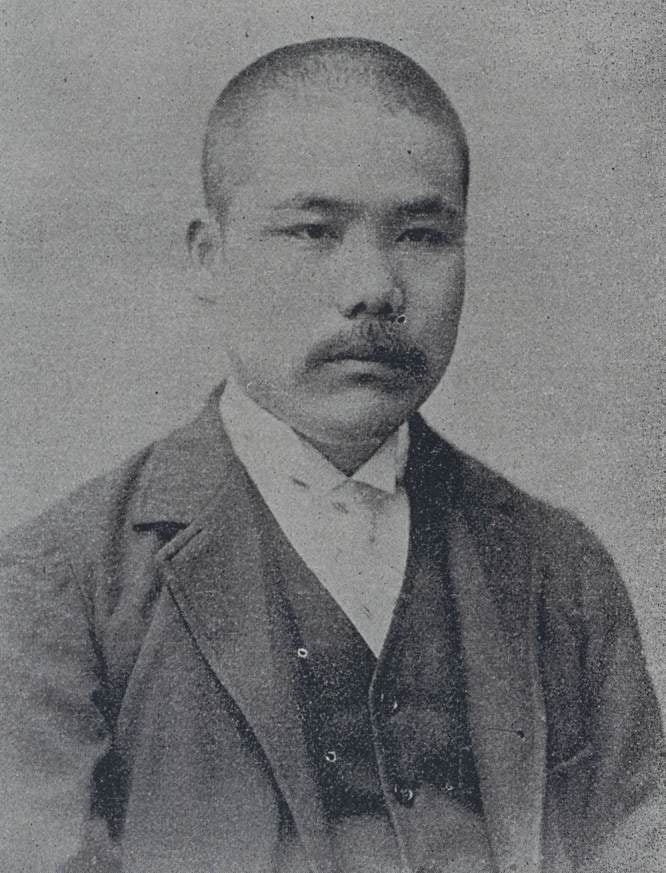
Hashimoto Shinkichi and Shinmura Izuru, whom we’ve read so far in this series, belong to the generation taught by Ueda Kazutoshi (1867–1937); so does Kanazawa Shōzaburō. As a professor at Tokyo Imperial University, Ueda was one of those who rooted linguistics in Japan. His work runs in two broad directions.
Two works
- Concrete research on the sounds and forms of Japanese. “P-on-kō” (the argument that the ha-row was once P) and “Sokuon-kō” (how the small tsu of motte and itte arises) are the representatives. Both reason out the history and mechanism of sounds from everyday examples.
- Advocacy of the idea of “kokugo.” In “Kokugo to kokka to” he argued that unifying the language of the people is a task for the state. In “Hyōjungo ni tsukite” he explained, with European examples, how a standard language is made and kept.
A map of this feature
First, three articles on Japanese itself: the P sound seen through the “po” of okorippoi (Plain-language explainer 1); the gemination in motte and itte (Plain-language explainer 2); and how a standard language is made (Plain-language explainer 3). Then we read two passages of Ueda’s own writing: how he reasons in “P-on-kō” (Close reading 1) and the claims of “Kokugo to kokka to” (Close reading 2). Finally, we sort out present-day assessments in the verdict article.
A caveat up front
“Kokugo to kokka to” ties language tightly to the state and is political in character. This feature neither praises nor condemns Ueda; it checks in the original what was said at the time, and sorts out, as fact, how it was received afterward in the verdict article. Also, the “present treatment” in the verdict article is a generally known summary of Japanese linguistics, not a one-by-one check of individual papers.
Summary
| Point | Detail |
|---|---|
| Who | Ueda Kazutoshi (1867–1937, professor at Tokyo Imperial University) |
| Primary sources | Kokugo no tame (1897) and Kokugo no tame, Part 2 (1903) (freely viewable at the National Diet Library) |
| Two works | Research on sounds of Japanese (P-on-kō, Sokuon-kō) and advocacy of the frame of “kokugo” |
| Caution | Claims tying language to the state are political; read the words of the time and later reception separately |
In a nutshell — from an everyday word like okorippoi, Ueda Kazutoshi reasoned out an old sound, and with the same hand he spoke of the frame of “kokugo” as a task of the state. We check both in the original.
