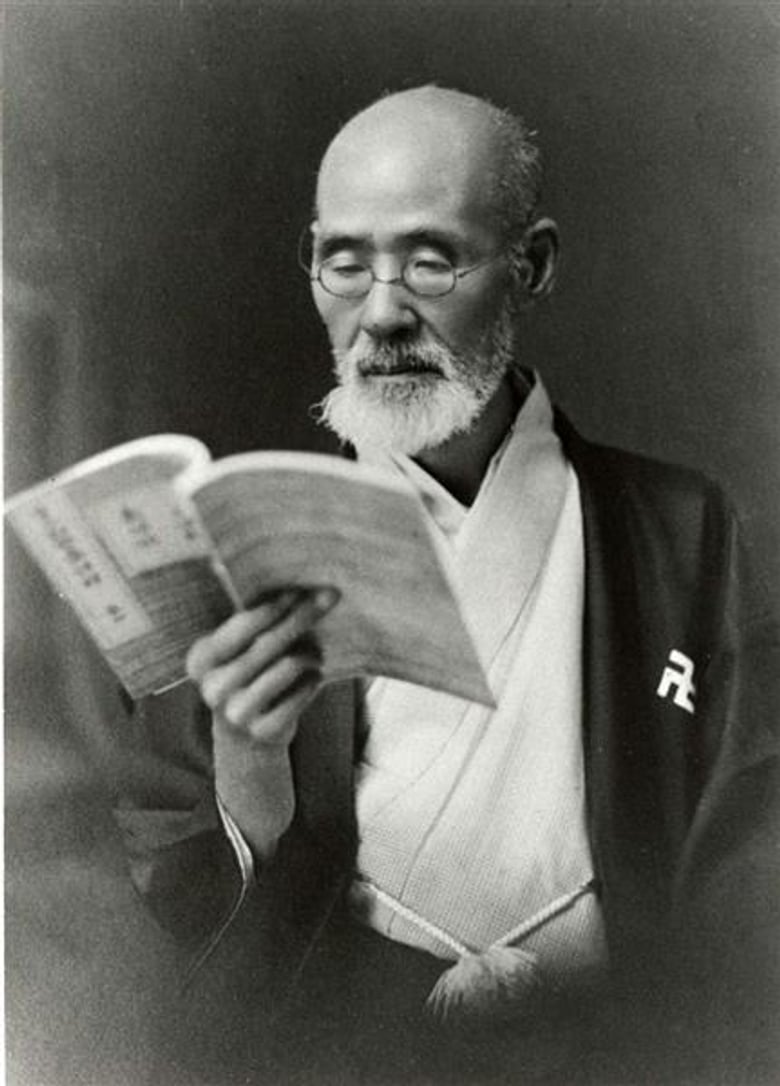
This site’s features have, until now, followed the history of Western comparative linguistics. From here, we turn to how modern language study took shape from within a single language, Japanese, through nine scholars of “kokugogaku” (national language studies). The first is Ōtsuki Fumihiko (1847–1928), editor of Japan’s first modern national dictionary, Genkai (言海, “Sea of Words”).
“Make a dictionary of the national language” — and nothing more
In early Meiji-era Japan, there was, in fact, no such thing as a “modern national dictionary.” Edo-period Japan had practical wordbooks like the Setsuyōshū, and dictionaries like the Wagyokuhen that arranged Chinese characters by semantic category. But a dictionary that arranged Japanese words in gojūon (fifty-sound) order and explained each word, in Japanese, using Japanese — something taken utterly for granted today — did not yet exist anywhere.
Ōtsuki Fumihiko, son of the Dutch-studies scholar Ōtsuki Bankei of the Sendai domain, studied at Kaisei Gakkō, one of the forerunners of the University of Tokyo. Around 1875, Ōtsuki was summoned by the Ministry of Education, where Nishimura Shigeki, head of its compilation bureau, ordered him to compile a dictionary of the national language. This background is recorded in Nishimura’s own preface (written in classical Chinese) at the front of Genkai.
A task with no model to follow
The order came with almost no concrete guidance. The shape of a Western dictionary, like Webster’s, was known as a reference point — but no one had yet attempted to describe the Japanese language itself, in gojūon order, with parts of speech marked and pronunciation notated. Ōtsuki himself speaks candidly about this in his preface (covered in detail in the close-reading article).
Fourteen years
From the order to the completion of the first edition, Ōtsuki spent roughly fourteen years. Beyond simply collecting words and writing definitions, he had to design, almost from scratch, a new system of arrangement (gojūon order), a notation for pronunciation and accent, and a scheme for classifying parts of speech. The finished manuscript went through review by the Ministry of Education, and was ultimately published, at Ōtsuki’s own expense, in four volumes between 1889 and 1891.
The map of this feature
This feature begins by introducing, without jargon, two innovations Genkai brought to Japanese: arrangement by gojūon order, and the method of explaining Japanese in Japanese. It then closely reads Genkai’s preface and “The Main Intent of This Book’s Compilation” in the original, in Ōtsuki’s own words. From there, it covers the connection to the Meiji government’s national-language policy that supported this project, and closes with an assessment from more than 130 years later.
Summary
| Point | Detail |
|---|---|
| Who | Ōtsuki Fumihiko (1847–1928, from the Sendai domain, a scholar of Japanese classical studies) |
| Landmark work | Genkai (1889–1891, 4 volumes) |
| Background | Compilation ordered around 1875 by Nishimura Shigeki, head of the Ministry of Education’s compilation bureau |
| Time taken | About fourteen years, from order to completed first edition |
In a nutshell — with no model to follow, Ōtsuki Fumihiko built, almost single-handedly, the very shape a Japanese dictionary should take.
