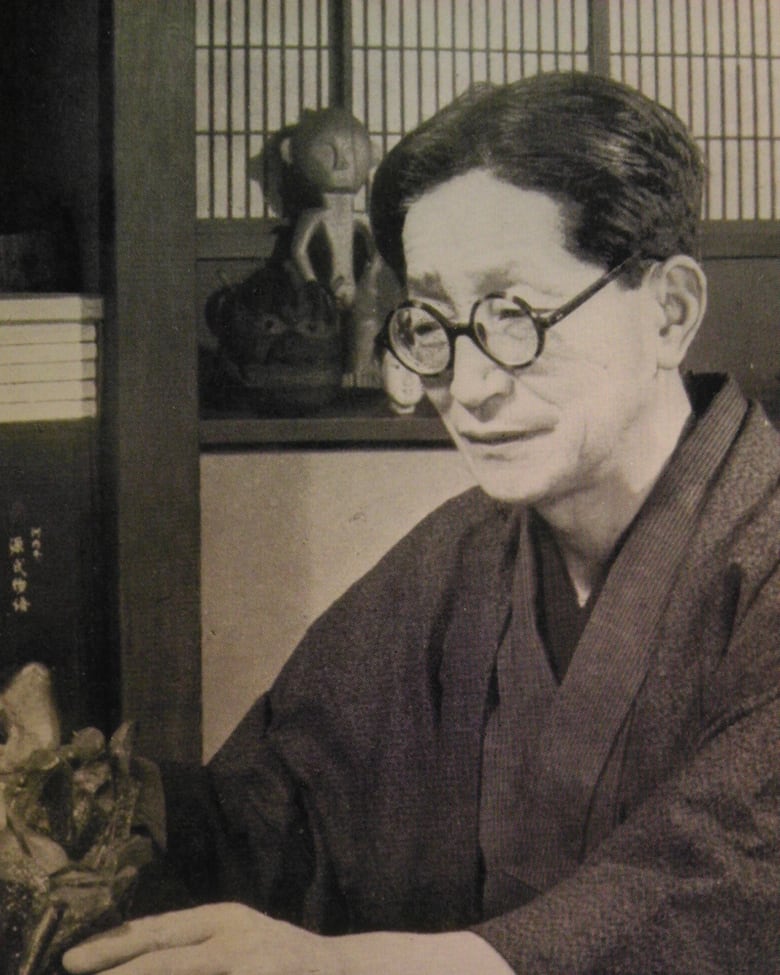
Orikuchi Shinobu (1887–1953) is known as a folklorist, a scholar of national literature, and, under the name Shaku Chōkū, a poet. What this feature reads is what Orikuchi said about the Japanese language itself. He tried to re-read words not as symbols in a dictionary but as things that lived within the life and belief of ancient people.
Two primary texts
The primary sources of this feature are Orikuchi’s own writings, included in Aozora Bunko.
- “Kokugo to minzokugaku” (“Japanese and Folklore,” a 1937 lecture record) — concrete word stories: the change in the meaning of itoshi, the origin of haikara, and kotodama (“word-spirit”).
- “Gokon-ron no danpen” (a fragment on the theory of word roots, 1931) — a short paper observing the make-up of old words such as hashi (“bridge”), kataoka, sakadaru (“sake barrel”), and kogane (“gold”).
What this feature reads
First, three articles that look at examples of words: itoshi (Plain-language explainer 1); haikara (Plain-language explainer 2); and the word order of ancient compounds (Plain-language explainer 3). Then we read two passages of Orikuchi’s own writing: the passage on kotodama (Close reading 1) and the paper on changes in the form of word roots (Close reading 2). Finally, we sort out how Orikuchi’s various theories are treated today, in the verdict article.
A caveat up front
Orikuchi’s writing is less strict etymological research than richly inventive lectures and papers. Orikuchi himself, in the lecture, disclaims — “I cannot yet tell this story completely” — and in the paper he says, “Once word research is pushed beyond a certain point, it inevitably becomes conjecture.” This feature, too, does not present Orikuchi’s theories as simply correct. Its main aim is to read apart what Orikuchi observed and where he himself marks the start of conjecture.
The quotations in this feature are from the Aozora Bunko electronic texts. Aozora Bunko is typed and proofread by volunteers, and this feature did not check the original page images. Each article’s sources section says so.
Summary
| Point | Detail |
|---|---|
| Who | Orikuchi Shinobu (1887–1953, folklorist, scholar of national literature, poet) |
| Primary sources | “Kokugo to minzokugaku” (1937) and “Gokon-ron no danpen” (1931) (Aozora Bunko) |
| Words read | itoshi, haikara, hashi and kataoka, kotodama, sakadaru, etc. |
| What to watch | The line between observation and conjecture; reading words through life and belief |
In a nutshell — Orikuchi Shinobu read each word of Japanese as a clue to the life and belief of ancient people, and in doing so plainly marked the limits of his own conjectures.
