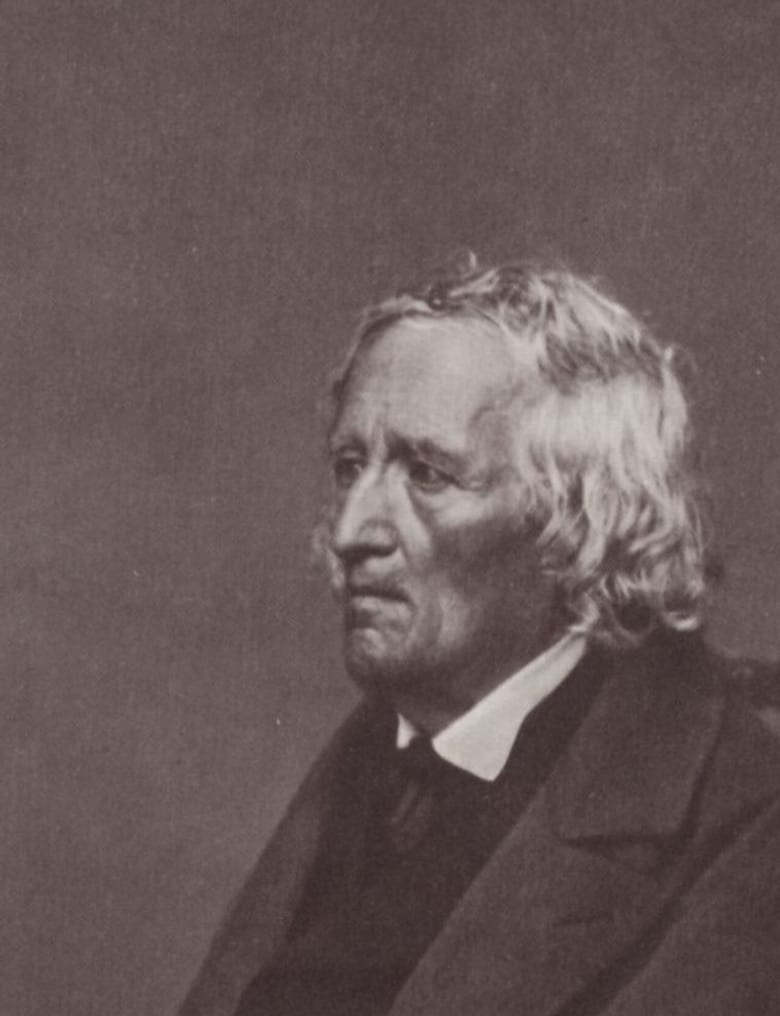
The Brothers Grimm are read worldwide as “the brothers who collected fairy tales.” But the elder of the two, Jacob Grimm (1785–1863), brought the same hand to language itself. One table, written on one page of the 1822 second edition of his Deutsche Grammatik (German Grammar), Part I — this is the origin of what would later be called “Grimm’s Law,” one of the most famous discoveries in the history of language study.
From lawyer to philologist
Grimm was born in Hanau, in what is now Germany, and studied law at the University of Marburg. His teacher was Friedrich Carl von Savigny, who would go on to found the “Historical School” of jurisprudence — the position that law is not something a legislator drafts at a desk, but something that grows organically out of a people’s history. That view would leave its mark on how Grimm later approached language itself. Language, too, is not an object you fit rules onto after the fact — it is something that has changed, regularly, within its own history. That intuition took shape during his move from law to philology.
The same period saw Jacob begin, with his brother Wilhelm, the collection of folk tales and legends published from 1812 as the Children’s and Household Tales. Their shared editorial principle — record dialect and old turns of phrase as faithfully as possible, without smoothing them over — carried straight through into their language scholarship. Describe what has grown naturally within a people’s history, as it actually is — for Grimm, collecting fairy tales and studying grammar were not two separate jobs, but two expressions of one scholarly passion.
Deutsche Grammatik — from first edition to second
The plan for a four-part Deutsche Grammatik got underway in 1819, with the first edition of Part I. But compared to what followed, that first edition was still a modest piece of work. The turning point was a prize essay the Danish scholar Rasmus Rask published in 1818 — investigating the origin of Icelandic (Old Norse), Rask showed that Germanic consonants diverge from their counterparts in other Indo-European languages with a definite regularity. Reading it, Grimm recognized exactly what his own work had been missing. So in 1822 came a second edition more than double the length of the first, with an entirely new chapter added: “Comparison of Foreign Letters” (Vergleichung fremder Buchstaben).
One table — the “twofold sound shift”
Near the end of that chapter, on page 584, Grimm writes:
Die ganze für Geschichte der Sprache und Strenge der Etymologie folgenreiche zweifache Lautverschiebung stellt sich tabellarisch so dar: (The entire twofold sound shift — so consequential for the history of language and the rigor of etymology — presents itself in tabular form as follows:)
The table that follows lays out, in a simple three-row grid, how consonants like p, t, and k shift in step across Greek, Gothic, and Old High German. Latin pater becomes Gothic fadar, Old High German fater — and Grimm presented this regular shift not as a set of isolated word-by-word coincidences, but as one systematic pattern running through the whole language. The content of the table and how to read it are covered in the next article in this feature, and in the close reading of the original text.
Map of this feature
This feature reads the discovery from several angles. The next two pieces explain, without jargon, what the discovery actually says and the background of the man who made it. The three after that offer a close reading of the 1822 original itself, the story of how an “exception” that dogged the law was resolved half a century later, and the legacy of the very idea of a “sound law” for linguistics as a whole. The feature closes with an article testing the law from two centuries’ distance.
Summary
| Point | Content |
|---|---|
| Who, when | Jacob Grimm, 1822, Deutsche Grammatik Part I, 2nd edition |
| Background | Fairy-tale collecting with brother Wilhelm; the influence of Savigny’s Historical School |
| Immediate trigger | Rasmus Rask’s 1818 prize essay |
| Central discovery | The “twofold sound shift” — regular consonant correspondences across Greek, Gothic, and Old High German |
| Later name | Grimm’s Law |
In a nutshell — the same hand that recorded fairy tales as they actually were found the same kind of plain regularity inside the changes of language itself. This feature begins on that one 1822 page.
_(Zeno_Fotografie).jpg)